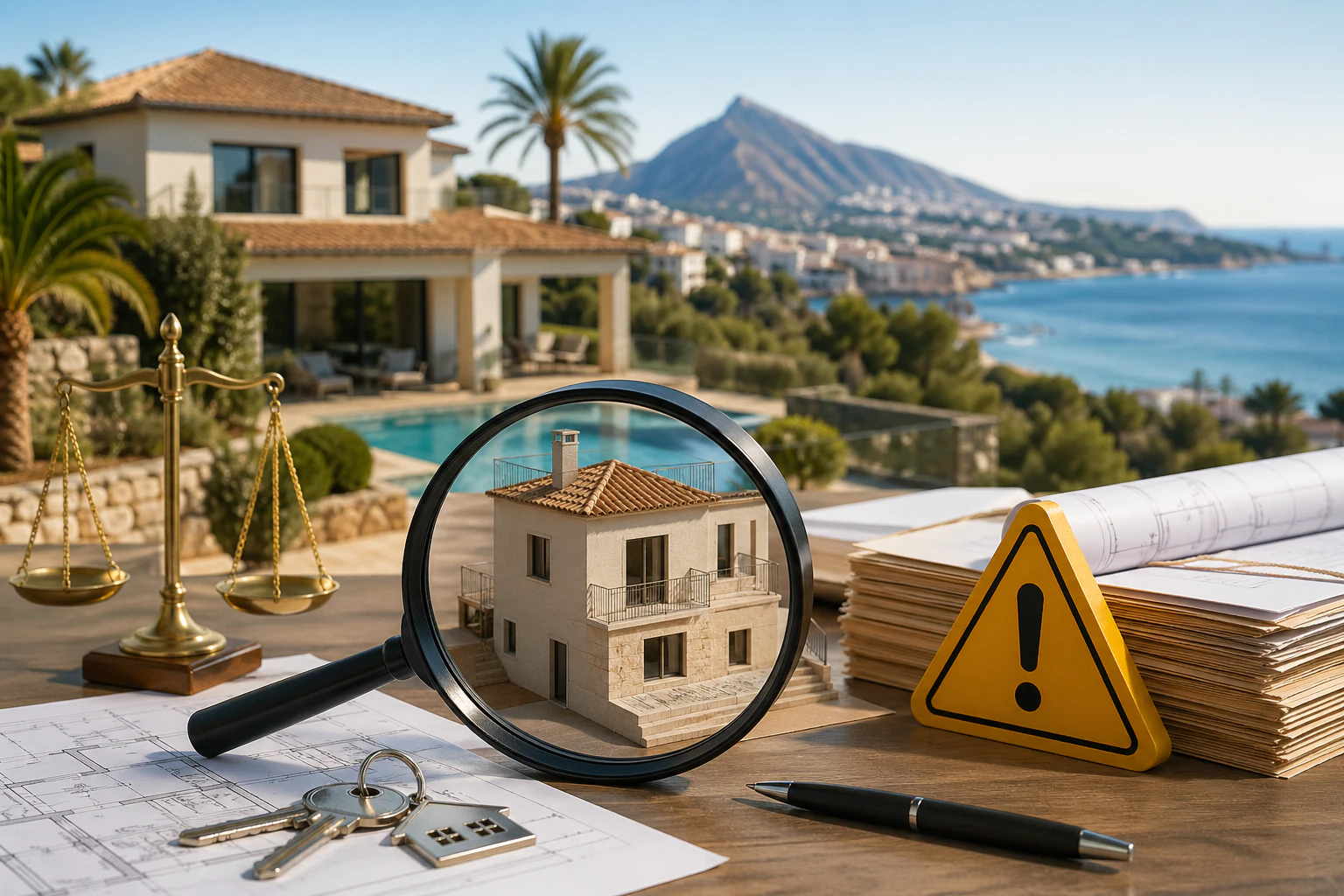
UNREGISTERED PROPERTIES ON THE COSTA BLANCA: PROBLEMS AND SOLUTIONS
In attractive areas such as Altea, Albir, La Nucía and, more generally, the whole of the Costa Blanca, it is relatively common to find properties that are not fully registered from a legal or planning perspective.
Although many owners are unaware of this situation, the lack of regularisation of a property can lead to significant problems, particularly when it comes to selling, inheriting or financing the property.
In this article, we explain clearly and professionally what it means for a property not to be regularised, why this happens, what the consequences are and how it can be resolved.
What is an unregistered property?
An unregistered property is one whose actual condition does not fully correspond to its legal or registered status.
Among other reasons, this may be because:
The property is not registered in the Land Registry
There are undeclared constructions or extensions
The Land Registry data does not match reality
The property does not have the appropriate planning permission
In other words: the house physically exists, but it is not correctly reflected in the official registers or does not comply with current regulations.
Why are there unregistered properties?
The most common causes on the Costa Blanca are:
1. Undeclared building works: Extensions, swimming pools, garages or enclosures built without a planning permission or without being subsequently registered.
2. Older properties: Many properties built decades ago were never brought into line with current regulations or properly registered.
3. Buildings on rural land: This is particularly common with detached houses or country homes, where construction historically took place without the current planning controls.
4. Lack of coordination between the Land Registry and the Cadastre: Discrepancies regarding the property’s area, location or description.
5. Unformalised inheritances: Inherited properties that have not been properly transferred or registered in the names of the new owners.
Problems with an unregularised property
The lack of regularisation can have consequences of varying severity. For example:
1. Difficulties in obtaining a mortgage: Banks require legal certainty and, if there are irregularities, they may refuse financing or reduce the loan amount
2. Loss of market value: If potential buyers of an unregistered property perceive a risk, there will be lower demand and the property owner will likely have to lower the price in order to sell it.
3. Problems with the sale: Failure to regularise a property can lead to delays at the solicitor’s office or the requirement for additional documentation that is not always easy or quick to obtain, which may result in the potential cancellation of the sale
4. Legal risks and penalties: In some cases, a lack of regularisation may lead to the initiation of planning proceedings, fines or even demolition orders in serious situations.
5. Buyer mistrust: This is particularly true for foreign buyers, who seek maximum legal certainty.
How can a property be regularised?
The solution depends on each individual case, but the main options are:
1. Declaration of new build: This allows existing buildings to be registered in the Land Registry. This procedure requires a certificate from a qualified professional, usually an architect, confirming the age of the building or its legal status.
2. Planning legalisation: If the building can be legalised, the relevant planning permission must be applied for
3. Regularisation by prescription: After certain time limits have elapsed, the infringement and penalties may be considered time-barred
4. Cadastral–Land Registry correction: Adjustment of floor areas, boundaries and property description.
5. Title deeds or notarial procedures: For more complex cases of ownership or demarcation.
6. Design of a legal strategy for sale: Where the property cannot be fully regularised, the sale must be structured in the best possible way and the buyer must be properly informed
Real-life case in Altea
Villa with:
120 m² registered in the Land Registry
180 m² actual (undeclared extension)
Problem:
The buyer cannot obtain a mortgage
Mistrust regarding the transaction
Solution:
Technical report verifying the property’s age
Declaration of new construction
Update in the Land Registry
Result:
✔ Sale viable
✔ Increase in the property’s value
Conclusion
Non-regularised properties are very common in Altea and throughout the Costa Blanca and should not automatically cause alarm, but they do require analysis, strategy and professional advice.
It is not the problem itself that prevents the sale of an unregistered property. The problem is not knowing how to identify it or how to manage it.
Do you have an unregistered property?
Whether you want to sell or are thinking of buying an unregistered property, contact us and we will tell you exactly:
What the exact problem is
Whether it affects the transaction a little, a lot or not at all
How to solve it
How can ALTEAINVEST help you?
At ALTEAINVEST we help you to:
✔ Analyse the actual situation of the property you wish to sell or buy
✔ Identify risks and opportunities
✔ Regularise the property (to the extent possible)
✔ Design the best sales strategy
ALTEAINVEST offers security, strategy and results in every transaction.


